How do clients feel about agencies using AI?
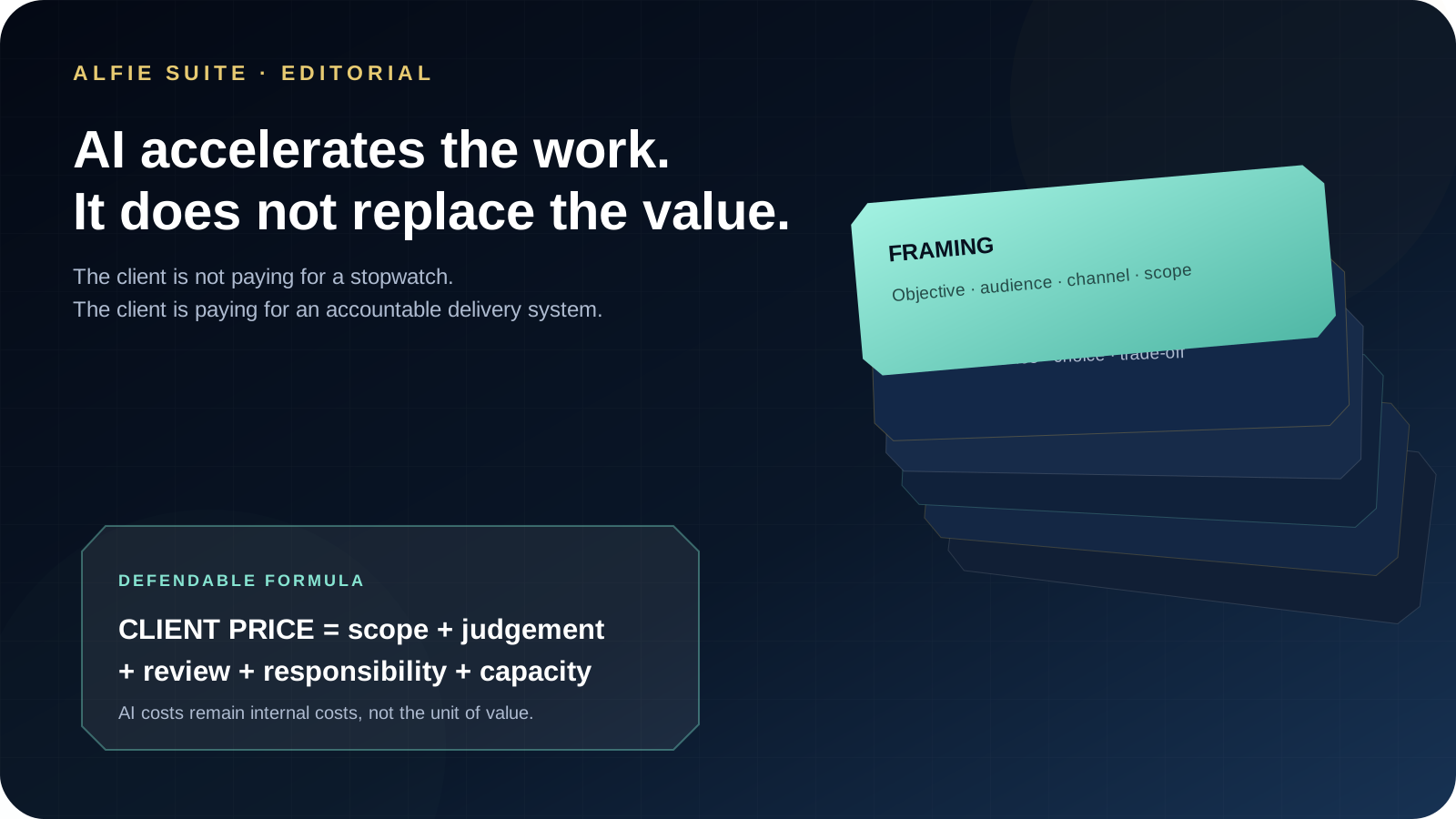
Clients do not reject AI in marketing agencies. They reject weak work, hidden automation and the feeling that they are paying a premium price for a process nobody is willing to own.
Nathalie StaelensGhostwriter and Web Writer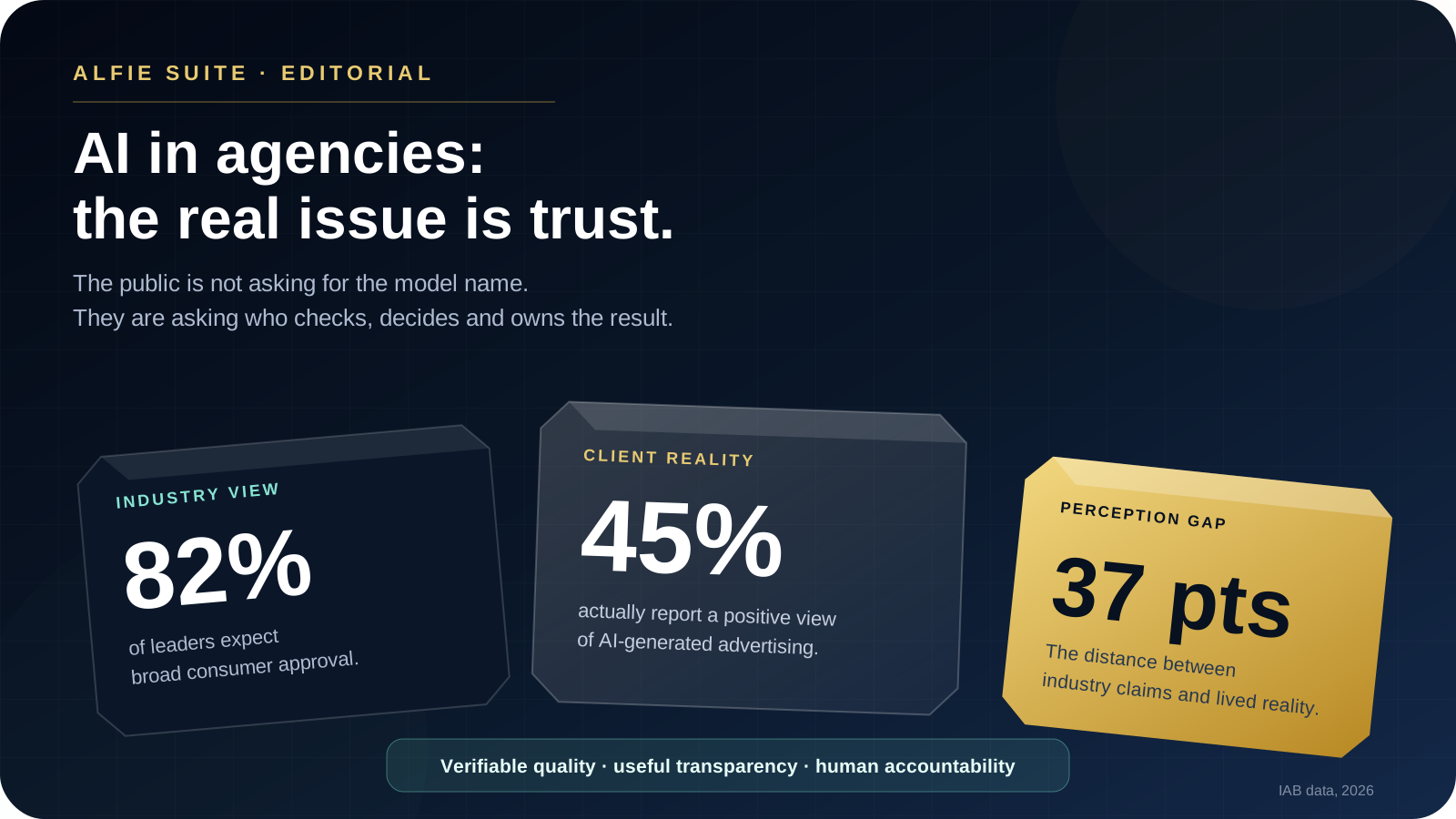
At half past nine, in a meeting room that is too white, a client places his phone on the table. He has seen the visual. He has read the copy. The work is clean. Yet something holds him back.
“Who made this?”
It sounds like a simple question. It is not. The client is not really asking for the name of the software. He is looking for the person who chose the angle, checked the numbers and will answer if the image resembles a competitor’s campaign or if a polished sentence turns out to rest on nothing.
That is where the perception of AI in a marketing agency is decided. Not inside the model, but in what the model reveals about the agency: its quality, its transparency, its appetite for risk and the presence — or absence — of a human being able to say, “This decision is mine.”
Clients are not judging the tool. They are looking for the owner of the decision
An agency can use a spreadsheet, editing software or a stock library without issuing a press release. AI provokes a different reaction because it enters sensitive territory: creation, personal data, intellectual property, factual accuracy and sometimes the identity of the person who appears to be speaking.
The client is therefore not only asking whether artificial intelligence was involved. The questions underneath are more practical:
- Where did our information go?
- Was the text reviewed or merely copied from an output?
- Does the image respect the product, the brand and third-party rights?
- Could a quote, statistic or testimonial have been invented?
- Who will correct the work if it fails publicly?
- Is the time saved being used to improve the service, or only to widen the margin?
These questions are not hostile to progress. They are hostile to the silent transfer of risk.
The widening gap between the industry and the public
Inside the industry, AI is often presented as a settled matter. It is faster. It produces more variants. It makes creative work look like a material that can be stretched on command. Outside those rooms, the reaction is less intoxicated. People see the usefulness, but they also recognise the fake, the approximate and the enthusiasm of those who discovered a button before they discovered a method.
In January 2026, the IAB found that 82% of advertising executives believed Gen Z and Millennial consumers viewed AI-generated advertising positively. Only 45% of the consumers surveyed actually reported a positive view. The gap was 37 percentage points — wide enough to become a strategic problem.
The same study offers an important qualification. For 73% of younger consumers, learning that an advertisement had been created with AI would either increase or not change purchase intent. Disclosure does not automatically trigger rejection. It becomes dangerous when the quality is weak, the authenticity feels manufactured or nobody appears to have remained in control.
The Nuremberg Institute for Market Decisions ran experiments with 3,000 people in the United States, the United Kingdom and Germany. Only 20% said they trusted AI itself. Identical advertising was judged more harshly when it was labelled as AI-generated, particularly on emotional and natural qualities.
Adobe has measured another mismatch. In its 2026 AI and Digital Trends report, 49% of organisations believed customers would eventually prefer interacting with brands mainly through AI agents. Only 19% of customers shared that expectation. A third said they might disengage after discovering content was AI-generated, and 37% might disengage after believing they were speaking to a human and later learning it was a machine.
The public is not behind. It is simply less dazzled than the people selling the novelty.
What clients usually accept without drama
AI is accepted most easily when it stays in the workshop rather than sitting on the throne.
Speeding up work with little relational value
Summarising a meeting, organising documents, preparing a structure, adapting a format or checking whether required elements are present does not remove value from the client when the result is reviewed and owned.
Exploring more directions
An agency can compare angles, test variants and reject weak ideas more quickly. The client then receives more thinking, not merely more files.
Strengthening brand consistency
AI connected to a proper brand library can recall tone, exclusions, offers, evidence, references and previously approved language. It becomes useful because it reduces forgotten context and random drift.
Reserving human attention for decisions
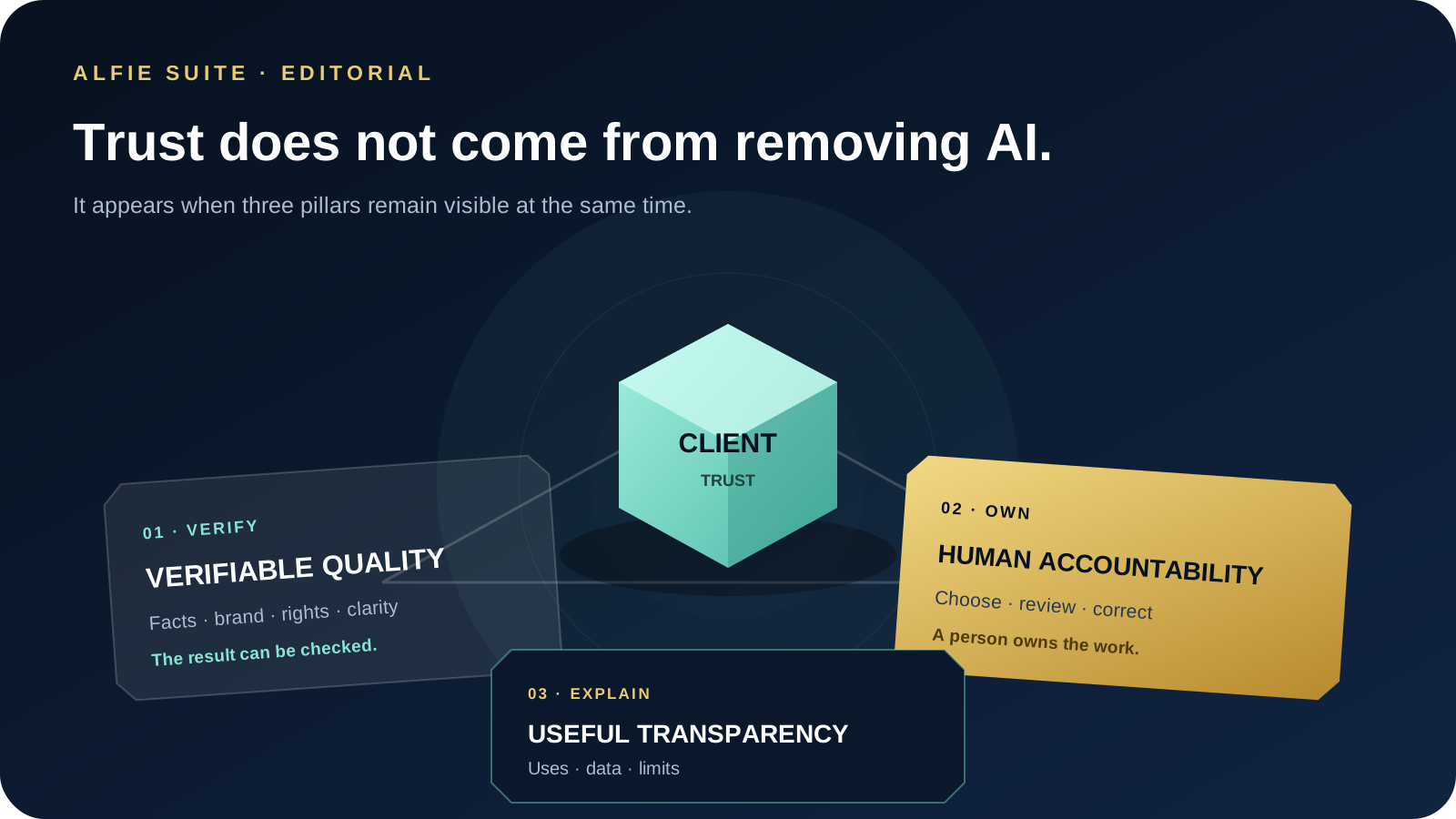
AI prepares. The agency chooses, verifies, decides, explains and takes responsibility. This division of labour inspires more confidence than promises of full autonomy, because full autonomy often sounds like an elegant way of saying nobody will be at the counter when something goes wrong.
The moment trust breaks
Suspicion rises when AI changes the nature of the service while the contract, the price and the agency’s language remain untouched.
Clients rarely need a list of model versions and temperature settings. They need to understand the limits, the safeguards around their data and who retains the final word.
Transparency is neither a confession nor a magic trick
Disclosing everything would be absurd. Explaining nothing would be reckless.
An agency does not need to announce every assisted correction, summary or semantic search. It should inform the client when AI affects consent, risk or the value the client reasonably expects:
- confidential or personal data is processed;
- a substantial part of public text, imagery, voice or video is generated;
- a synthetic appearance, voice or testimonial is used;
- an automated interaction is presented as human;
- an important step has no human validation;
- the production method changes significantly from what the contract described.
From 2 August 2026, transparency duties under Article 50 of the EU AI Act become applicable to certain interactions and generated or manipulated content. They do not turn every assisted draft into labelled material, but they reinforce an already clear direction: uses capable of misleading people must be identifiable and explained. European agencies should follow the European Commission’s work on AI-generated content and obtain appropriate legal advice for sensitive cases.
A credible agency AI policy has four commitments
One page can be enough, provided the page says something concrete.
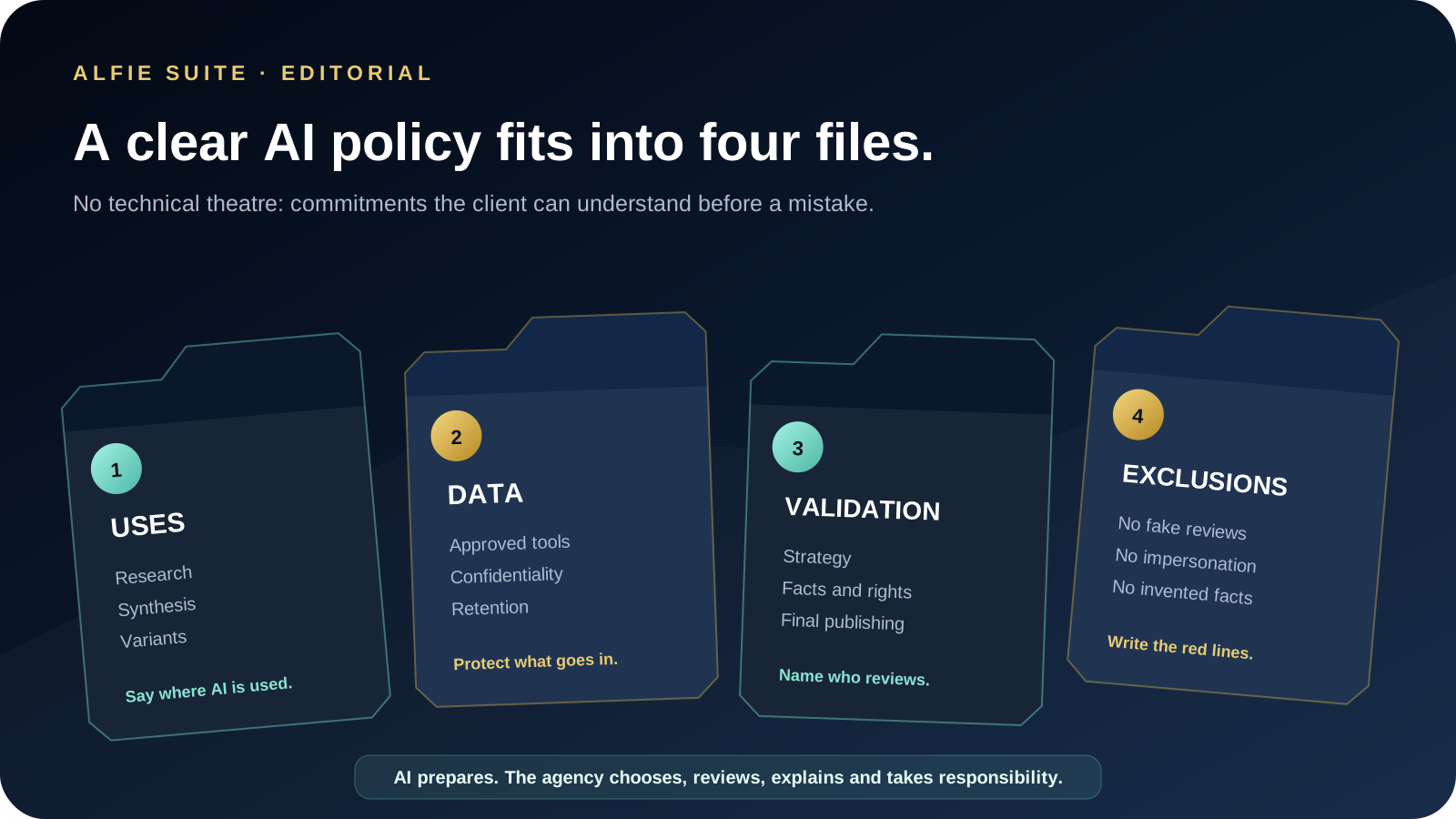
1. Explain where AI is used
Research, synthesis, initial directions, variations, checks and production assistance should be described in ordinary language.
2. Explain how data is protected
Name authorised tools, information that must never be uploaded, retention rules and any anonymisation requirements.
3. Name the human validation points
Strategy, facts, brand compliance, rights, final approval and publication: clients should know which steps remain under human responsibility.
4. Write down the prohibitions
No fake testimonials. No invented performance. No imitation of a person without consent. No autonomous publication when human approval was promised.
A policy like this does not slow down a sale. It prevents the AI conversation from exploding at the worst possible moment — after an error, a publication or an invoice.
How to talk about AI without diminishing the profession
An agency makes one mistake when it presents AI as a magic button. It makes another when it hides it like a shameful shortcut.
A stronger explanation is straightforward:
We use AI to accelerate research, structure, variants and selected controls. Strategy, creative choices, factual verification, brand compliance and final approval remain the agency’s responsibility. Your data is handled according to the rules set out in our AI policy.
This sentence does not pretend a human typed every comma by hand. It also does not pretend a machine possesses the taste, context and responsibility of a professional.
The same logic applies to price. AI does not automatically turn professional work into a cheap commodity. It requires the agency to explain more clearly what the client is buying. That question is developed in our guide to pricing AI-assisted agency services.
What this means for Alfie Suite
Alfie Suite is organised around Missions: one active brand, one objective, a recommendation, defined deliverables, validation points and an organised delivery. The value is not in exposing a pile of models to the user. It lies in preserving brand context, explaining the recommendation and maintaining control points before production.
That architecture answers the concerns clients raise most often:
- the Brand Library preserves the brand context;
- the Mission File makes sources, constraints and expected deliverables visible;
- Alfie recommends and the user validates before production;
- specialists contribute according to their role;
- a failed output is not presented as ready to publish;
- future Missions can take account of decisions already approved.
At the time of publication, Alfie Suite is in pre-launch, with opening planned for September 2026. The promise should not be “AI does everything.” It should be more demanding: AI works inside a system where the brand, the approval and the responsibility remain visible.
Sources
- IAB — The AI Ad Gap Widens, 2026
- IAB — AI Transparency and Disclosure Framework, 2026
- Adobe — AI and Digital Trends 2026
- NIM — Transparency Without Trust
- Hwang et al. — AI Disclosure in Freelance Work, 2026
- European Commission — Code of Practice on AI-generated content
- European Commission — European regulatory framework for AI